
Hard Anodizing Services for Robotics & Automation Components
RobotPartsCNC combines precision CNC machining with Type III hard anodizing for aluminum robot joints, actuator housings, structural parts, and other components exposed to continuous mechanical stress.
25–50 μm
Typical coating thickness
60–70 HRC
Equivalent hardness
1000 mm
Maximum part length
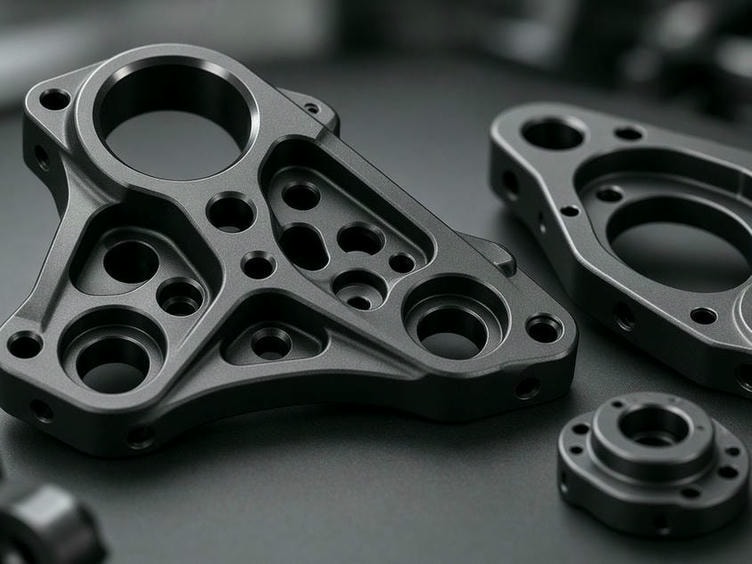
Precision first
Tool paths account for coating growth before production begins.
Integrated supply
CNC machining, finishing, inspection, and documentation managed together.
Built for demanding assemblies
Why hard anodizing matters in robotics
Type III hard anodizing creates a thick, dense aluminum oxide layer that outperforms standard decorative anodizing in moving, exposed, and high-load applications.
Wear resistance
Protects friction surfaces in robot joints, sliding mechanisms, actuator interfaces, and repetitive end-effector motion.
Corrosion protection
Improves service life in industrial, outdoor, medical, and moisture- or contaminant-prone environments.
Electrical insulation
Provides a dielectric surface for sensor housings, electronic mounting features, and selected grounding-aware designs.
High surface hardness
Achieves an equivalent hardness of typically 60–70 HRC to help prevent galling and surface degradation.
Process engineering
Precision machining that anticipates the coating
Hard anodizing grows chemically from the aluminum surface, so final dimensions must be planned during CNC programming rather than corrected after finishing.
Engineering checkpoint
Critical bores, bearing seats, threaded interfaces, and assembly fits are reviewed for post-anodize tolerance and clearance.
Dimensional compensation
Tool paths are adjusted for the typical 25–50 μm coating thickness, with a stated ±10% thickness tolerance. This protects critical features after finishing.
Masking and mating surfaces
We mask electrical grounding points, tight-tolerance mating surfaces, internal threads, and other areas that must remain uncoated or assembly-ready.
Material selection
Our process is suited to 6061-T6, 7075-T6, and 2024 aluminum alloys, which respond predictably for consistent, high-quality finishes.
Specification guide
Technical specifications for robotics components
Define the coating, surface preparation, dimensions, and appearance required for your assembly before production release.
Application fit
Surface protection where motion and exposure meet
From robot joints to mobile-drive assemblies, we manufacture and finish aluminum parts for repeated movement, contact, and environmental exposure.
Actuator and reducer housings
Protects internal gear interfaces from wear.
Robot joint housings
Supports structural integrity against contaminants and repeated loading.
End-effector fingers
Provides durable, high-grip surfaces for repetitive picking tasks.
AMR and AGV drive housings
Protects exposed drive components from debris and moisture.
Sensor and camera mounts
Creates a non-conductive, durable finish for mounting brackets and electronic hardware.
Quality documentation
Inspection before and after anodizing
Surface finish is part of the quality record. Inspection verifies the coating and the underlying precision features that determine assembly performance.
- ●Coating thickness: Eddy current or magnetic gauge verification.
- ●Dimensional accuracy: CMM and bore gauge inspection of post-anodized features.
- ●Adhesion: Verification that the coating does not crack or peel under mechanical stress.
- ●Surface roughness: Confirmation that the final finish meets your Ra requirements.
DFM support
Design review for predictable finishing
External edges and corners +
Hard anodizing can build up on sharp corners and create brittle edges. We recommend a minimum external radius of 0.2–0.5 mm.
Blind holes and cavities +
Deep, narrow cavities can experience uneven current distribution. We advise on hole depth-to-diameter ratios for consistent coverage.
Assembly fits +
Clearance calculations account for coating growth so finished parts assemble correctly without compromising wear surfaces.
Shenzhen manufacturing
One managed path from raw material to finished assembly
Located in Shenzhen, RobotPartsCNC manages raw material sourcing, precision CNC milling, professional hard anodizing, final assembly, and quality documentation through a specialized secondary-process supply chain. This integrated approach minimizes lead times and keeps CMM reports, material certificates, and finishing certificates at the source.
Suitable for
Prototype through volume production
Share your drawings and performance requirements for engineering feedback before production.
Request a quote
Let’s review your hard anodizing requirements
Send your CAD files, material, coating thickness, masking requirements, critical tolerances, and expected volumes. Our engineering team will help define a reliable path from prototype to production.
Email: info@robotpartscnc.com
Location:
RobotPartsCNC
Precision CNC Parts for Robotics & Automation
Start your project inquiry
Include part drawings and any requirements for fit, finish, inspection, or documentation.