
Precision CNC Turning Services for Robotics and Automation
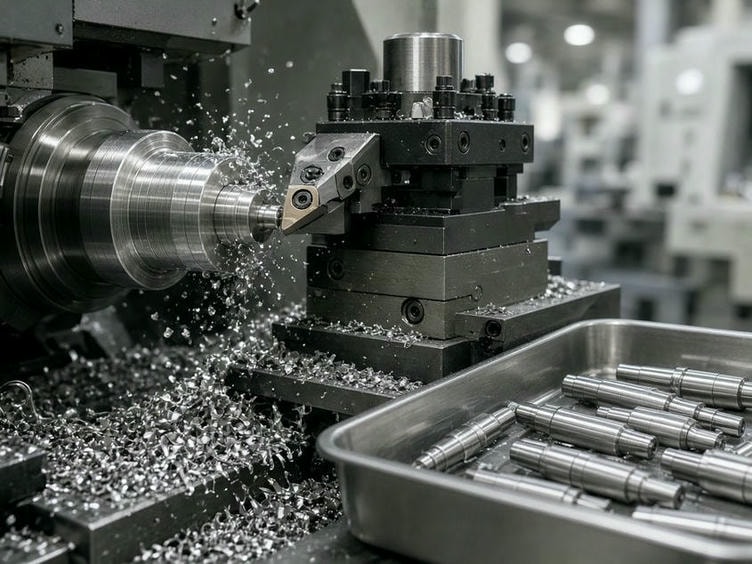
RobotPartsCNC provides precision CNC turning and mill-turn services for robot shafts, pins, sleeves, actuator housings, output flanges, and other critical rotary components.
From single-piece prototypes to production batches of 10,000+ parts, our Shenzhen facility supports demanding requirements for outside diameters, internal bores, threads, concentricity, runout, surface finish, and complex turning-milling operations.
±0.005
Tight tolerance capability, mm
Ø400
Maximum turning diameter, mm
3–7
Prototype lead time, working days
Built around rotating assemblies
Specialized turning for robotics components
Robotic joints, actuators, drive modules, and end-effectors depend on rotating elements with precise alignment, balance, and durability. We machine the interfaces that keep those systems moving reliably.
Focus areas for your design
Outside diameters, bearing fits, internal bores, threaded ends, bolt patterns, pilot diameters, keyways, cross-drilled features, and concentric assemblies.
Robot shafts and pins
Precision-turned shafts and custom pins with tight diameter tolerances, keyways, threaded ends, and specified hardness or surface requirements.
Actuator housings
Turned bodies with precision internal bores for bearing seats and gear assemblies, including requirements for wall thickness and dimensional stability.
Output flanges
High-strength flanges with accurate bolt patterns and pilot diameters for motor, gearbox, and robotic joint connections.
Sleeves, bushings, and drive parts
Thin-walled sleeves, precision bushings, hubs, and pulleys for joint assemblies and AMR or AGV drive modules.
One setup, more control
Mill-turn capability for complex rotary parts
Standard turning is often not enough for robotic components with off-center holes, flats, slots, and cross-drilled features. Our mill-turn centers combine turning with live tooling so more features can be completed in a single setup.
Improved accuracy
Machining multiple features in one clamping reduces cumulative errors between turned diameters and milled features, supporting concentricity and perpendicularity requirements.
Reduced lead times
Consolidated operations reduce handling and setup time, accelerating the path from raw material to finished component.
Process capability
Turning + live tooling
Primary turned features
ODs, IDs, bearing fits, threads, relief grooves, tapers, and facing operations.
Secondary live-tool features
Flats, slots, cross-holes, off-center holes, bolt patterns, and milled details.
Application result
A controlled process for complex shafts, pins, sleeves, flanges, and actuator components.
Measured performance
Precision, tolerances, and quality control
Robotic performance depends on mechanical interfaces that remain accurate under motion. We routinely manage tight tolerances and GD&T requirements for bearing fits, shaft diameters, bores, and mating surfaces.
±0.01 mm
Standard tolerance
Capabilities down to ±0.005 mm for critical bearing fits and shaft diameters.
Ra 0.4–3.2
Surface integrity
Surface roughness control for seals, bearings, and mating parts.
GD&T
Geometric precision
Process control for concentricity, runout, and perpendicularity specifications.
CMM
Inspection workflow
CMM, bore gauges, thread gauges, and optical measuring equipment support production inspection.
Dimensional inspection reports and material certificates are available upon request for production runs and documented quality requirements.
At a glance
Technical specifications
A practical production range for robotics and automation components, from one-off engineering parts to repeat production programs.
| Capability | Specification |
|---|---|
| Max turning diameter | Ø400 mm |
| Max turning length | 800 mm |
| Standard tolerance | ±0.01 mm |
| Tight tolerance | Down to ±0.005 mm |
| Surface finish | Ra 0.4–3.2 μm |
| Quantity | 1 to 10,000+ pieces |
| Prototype lead time | 3–7 working days |
Material selection
Materials for strength, wear, and weight
We machine materials selected for load, corrosion resistance, wear resistance, machinability, and the strength-to-weight demands of robotic assemblies.
- ●Aluminum: 6061-T6 and 7075-T6 for lightweight structural parts and housings.
- ●Stainless steel: 303, 304, 316, 17-4PH, and 440C for corrosion resistance and high-strength shafts.
- ●Carbon and alloy steel: 1045, 4140, and 4340 for high-load structural components.
- ●Engineering plastics: POM/Delrin, PEEK, and Nylon for insulators, bushings, and light-load guides.
- ●Other materials: Brass, copper, bronze, and titanium.
From prototype to production
A manufacturing path that scales with your project
Prototyping
Fast-turnaround CNC turning for proof-of-concept builds, engineering verification, and design iteration. Quantities start from one piece.
Low-volume and production
Pilot runs and full-scale production are optimized for repeatability, consistent quality, and cost-efficiency.
Secondary operations
Our Shenzhen supply chain supports heat treatment, grinding, and surface plating to simplify your sourcing process.
Engineering support
DFM feedback before machining begins
Our engineering team reviews CAD models and 2D drawings to identify practical improvements before production starts.
Optimize wall thickness +
Review turned wall thicknesses to help prevent vibration and distortion during machining.
Improve internal bore geometry +
Refine bore geometry for reliable bearing seating and consistent assembly performance.
Refine threads and relief grooves +
Adjust thread specifications and relief grooves to improve manufacturability and tool access.
Select materials and finishes +
Identify cost-effective material and surface finish choices for the application and quantity.
Request a quote
Share your CNC turning requirements
Send your project details to our engineering team for a review of feasibility, tolerances, materials, lead time, and production requirements.
Please include:
- 3D CAD models and 2D technical drawings
- Material specifications and required quantity
- Surface finish and tolerance requirements
- Special inspection or documentation needs
We review STEP, STP, IGES, X_T, DWG, and PDF formats.
RobotPartsCNC
Email: info@robotpartscnc.com
Precision CNC Parts for Robotics & Automation — Prototype to Production.