
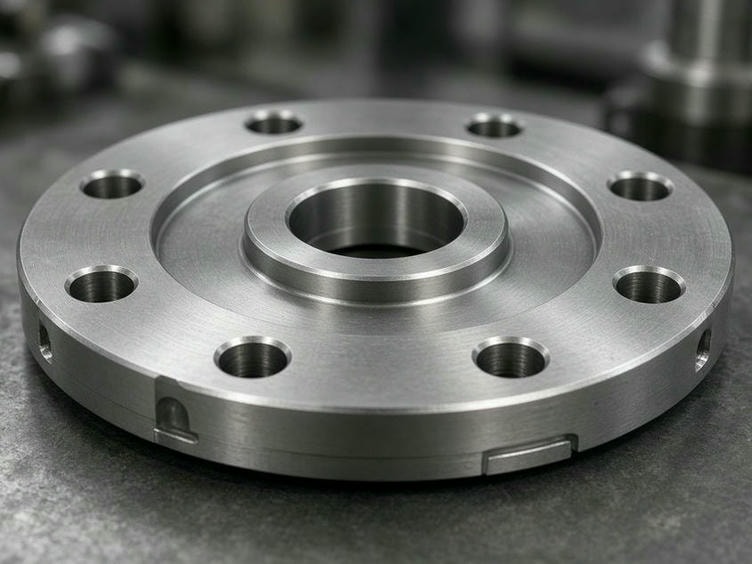
Precision CNC Machined Output Flanges for Robotics & Actuators
The output flange is the critical mechanical interface between a robotic actuator or gearbox and the robot arm, end-effector, or load. RobotPartsCNC manufactures custom flanges that transmit torque while maintaining precise alignment across the motion system.
±0.01 mm
Standard machining tolerance
±0.005 mm
Specialized interface capability
5-Axis
Complex features in fewer setups
Interface control
Flatness, parallelism, concentricity, and runout engineered around your assembly.
Application focus
Robot joints, actuators, gearboxes, bearings, and end-effectors.
Designed around your motion system
The flange sets the accuracy of the entire joint
Any deviation in flatness, concentricity, bore tolerance, or bolt-circle position can affect vibration, alignment, load transfer, and service life. We translate actuator design intent and GD&T requirements into repeatable machined parts.
Concentricity and runout
Maintains alignment between the gearbox output shaft, central bore, and flange outer profile.
Precision bores and fits
Supports bearing and shaft interfaces with specified interference or clearance fits such as H7/g6.
Bolt-circle accuracy
Controls true position for secure connections to robot joints, reducers, and end-effectors.
Flatness and parallelism
Protects the integrity of mating interfaces and helps distribute loads consistently.
Thin-wall machining without sacrificing rigidity
Optimized for lightweight robotic arms where mass reduction must be balanced with torque transmission and structural stiffness.
Manufacturing capabilities
Machining strategies for complex flange geometry
Our Shenzhen facility uses multi-axis CNC technology to reduce setups, preserve feature-to-feature accuracy, and deliver stable production results.
5-axis milling
Machines complex bolt patterns, pockets, and mounting features in a single setup to improve positional accuracy.
Mill-turn machining
Combines turning for the central diameter with milling for holes and peripheral features, preserving bore-to-profile concentricity.
Precision turning
Supports high-volume circular flanges with tight diameter tolerances and consistent surface finishes.
Material and finish selection
Matched to torque, weight, environment, and wear
Aluminum: 7075-T6 and 6061-T6
A lightweight choice for robotic joints and arm components. 7075-T6 is frequently selected for its strength-to-weight ratio.
Stainless steel: 303, 304, and 17-4PH
Used where corrosion resistance or higher structural strength is required, including medical and food-grade robotics.
Carbon and alloy steel: 4140 and 4340
Selected for heavy-duty industrial systems that prioritize torque transmission and wear resistance.
Protective treatments
Finishes for demanding operating conditions
Hard anodizing
Increases surface hardness and wear resistance for aluminum flanges.
Electroless nickel plating
Provides corrosion resistance and uniform thickness across complex geometries.
Passivation
Helps stainless steel resist oxidation while supporting surface purity.
Black oxide
Offers a cost-effective protective finish and uniform appearance for steel parts.
Quality assurance
Inspection built around your GD&T
Every batch is inspected against the geometric relationships that matter to your robotic assembly, from bolt-hole true position to bore concentricity and flange-face flatness.
Documentation available
Dimensional inspection reports, First Article Inspection reports, and material traceability documentation are available upon request for production orders.
CMM inspection
Verifies complex geometric relationships, true position, and bore concentricity.
Optical measurement
Checks dimensions, profiles, and accuracy of detailed flange features.
Precision gauges
Uses bore gauges, thread gauges, and micrometers for feature-specific verification.
Prototype to production
A practical path from first fit-check to repeat orders
RobotPartsCNC supports your product development lifecycle with scalable CNC manufacturing and process control.
Rapid prototyping
Quick-turn engineering samples help verify designs, test fits, and iterate on the robotic joint before larger commitments.
Low-volume production
Pilot runs, specialized robotics, and niche automation applications receive consistent process control across small batches.
Production manufacturing
Fixture optimization and batch inspection support stable tolerances, reduced lead times, and cost-efficient repeat orders.
Technical questions
Answers for actuator and robot-joint design teams
Request a quote
Bring your next actuator or robotic joint to production
Send your design details for a technical review and quotation. Our team can manufacture output flanges to your interface, material, finish, and GD&T requirements.
Please include
- 013D CAD models in STEP, STP, or X_T format
- 022D drawings with GD&T requirements
- 03Material specification and surface finish requirements
- 04Prototype or production quantity
RobotPartsCNC
Precision CNC Parts for Robotics & Automation