
Move robotics designs from CAD to production with confidence.
At RobotPartsCNC, our Design for Manufacturing support identifies machining risks before production begins. We help robotics teams optimize thin walls, deep cavities, tight fits, threads, and tool access for lower cost and shorter lead times.
3 / 4 / 5-axis
Machining strategies
±0.005 mm
Critical fit capability
Prototype to production
Lifecycle support
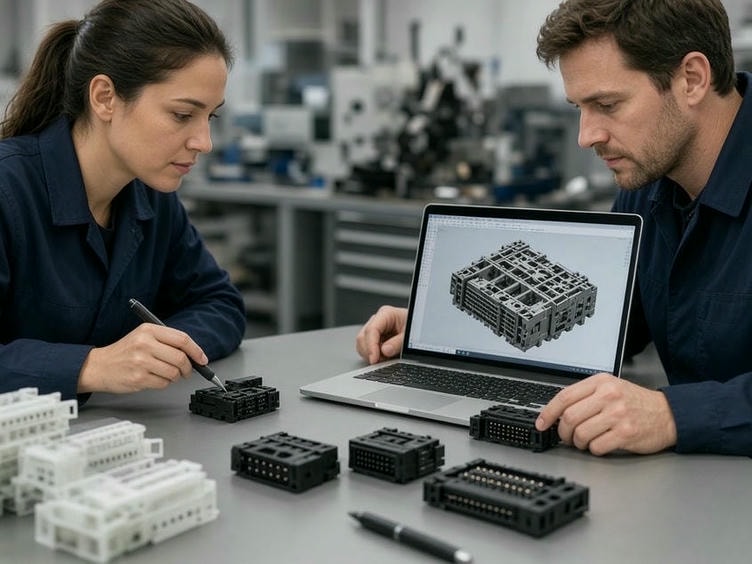
Engineering-first review
We assess how your part will be held, cut, inspected, and finished before the first chip is made.
From digital model to machine shop
Bridge the gap between CAD intent and manufacturing reality.
Robotics designs frequently combine complex geometries, lightweight structures, and tight tolerances. A part that appears straightforward in CAD may require custom tooling, multiple setups, or specialized fixturing once it reaches the machine shop.
Our engineering team reviews STEP and IGES files alongside 2D drawings with a focus on machine kinematics. We consider workholding, tool selection, material behavior, inspection requirements, and finishing operations so design decisions support a reliable production path.
Design risk review
Solve the features most likely to increase cost or delay delivery.
Our DFM feedback is practical and tied to the function of each robotics component. Where requirements allow, we recommend changes that use standard tools and fewer machining setups.
Thin walls and ribs
01Lightweight structures can vibrate or deform during cutting. We recommend workable wall thicknesses and ribbing strategies that preserve stiffness while improving stability.
Deep cavities
02Deep pockets often require long-reach tools, increasing deflection and chatter. We review depth-to-width ratios and corner radii to support standard tooling.
Internal radii
03Small internal radii force smaller end mills, slower feeds, and longer cycle times. We suggest larger radii where they do not compromise robot function.
Bearing bores and fits
04We verify tolerance classes, surface finishes, and machining allowances for reaming or boring so bearing seats perform as intended.
Threads and hole depth
05Deep threaded holes can exceed standard tap lengths and increase breakage risk, especially in stainless steel or titanium. We review usable thread depth and access.
Tool accessibility
06Obstructed features in joints and housings may require excessive setups. We identify access limitations and propose geometry changes that make complete machining practical.
A systematic review
How our DFM assessment works
We turn your models and drawings into clear manufacturing decisions before production begins.
-
1
File analysis
We assess STEP, STP, IGES, X_T, DWG, and PDF documentation for geometric feasibility and specification clarity.
-
2
Constraint identification
We flag features that may create scrap, excessive setup time, difficult inspection, or secondary processes not included in the initial plan.
-
3
Optimization feedback
We provide specific recommendations, such as relaxing a non-functional tolerance to a more achievable standard and reducing unnecessary machining cost.
-
4
Process planning
We outline the most efficient route, including whether 3-axis, 4-axis, or 5-axis machining is required and how the part should be set up.
The engineering impact
Optimize the design before the cost is locked in.
Reduced cycle times
Standard tool paths and practical geometry decrease time on the machine.
Lower setup costs
Fewer orientations and custom fixtures simplify production.
Improved yield
Early action on vibration and deformation reduces scrap risk.
Faster lead times
Fewer mid-production revisions keep your program moving.
Built for complex robotics parts
Capabilities that support your full product lifecycle.
From a first actuator prototype to recurring production batches, we refine the process for consistency and assembly readiness.
Multi-axis milling
3-, 4-, and 5-axis machining for housings, robot arms, and structural components.
Precision turning
Live-tool turning for shafts, output flanges, and motor mounts.
Tight-tolerance machining
Capability down to ±0.005 mm for critical fits and bearing seats.
Surface finishing
Anodizing, hard coating, and passivation integrated into the supply path.
For every stage of development
Scale from prototype validation to repeatable production.
Validate quickly
DFM feedback helps confirm that your first humanoid actuator, AMR housing, or custom gripper can be machined as designed.
Refine the process
We improve workholding, tool paths, tolerances, and finishing choices as the design moves toward repeatable batches.
Maintain consistency
A manufacturing strategy built early helps every batch meet functional and assembly requirements with fewer surprises.
Common questions
What to expect from a DFM review
Start an engineering conversation
Submit your project for a DFM assessment.
Send your robotics component files and our engineering team will review the requirements, identify manufacturing risks, and provide feedback for efficient CNC production.
RobotPartsCNC
info@robotpartscnc.com
Request your quote and DFM review
Include your 3D models, drawings, materials, quantities, and target schedule so we can assess the best production path.