
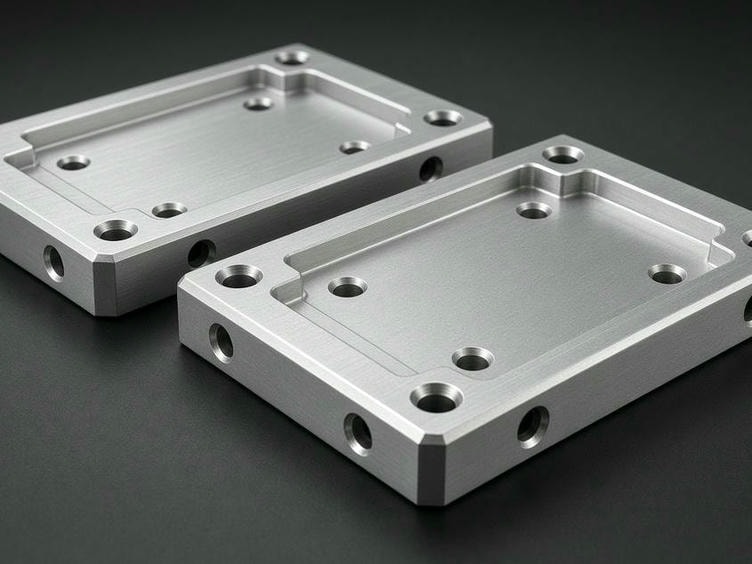
Precision CNC Machined Robot Base Plates
RobotPartsCNC manufactures custom robot base plates, mounting adapters, and structural interface components for industrial, collaborative, and mobile robotics systems.
Build a stable connection between your robot, factory floor, and equipment interface with controlled flatness, accurate hole patterns, and materials selected for high load and dynamic movement.
±0.01 mm
Standard tolerance
3–7 days
Prototype lead time
Engineering foundation
Stable interfaces for precise robot motion
A robot’s performance is limited by the stability of its mounting interface. Whether the plate connects a robot arm to the factory floor or adapts an AMR chassis to another structure, manufacturing precision affects vibration, repeatability, and system alignment.
Discuss your mounting interfaceFlatness and coplanarity
Level mounting surfaces help manage dynamic loads and maintain reliable robot alignment.
Hole pattern accuracy
Controlled true-position tolerances support accurate dowel pin and bolt pattern fitment.
Surface finish
Specified roughness helps prevent micro-vibration and creates a secure mechanical bond.
Structural integrity
Material and geometry are selected to reduce deflection under torque, acceleration, and high loads.
CNC manufacturing capabilities
From mounting brackets to large-format base frames
Our Shenzhen facility uses 3-axis and 5-axis CNC milling to produce robot foundation components against demanding mechanical specifications.
Materials
Aluminum and steel
6061-T6 and 7075-T6 aluminum for lightweight designs; 1045 and 4140 steel for high-load and high-impact environments.
Work envelope
Up to 1000 × 600 × 600 mm
Milling centers support compact adapters as well as larger robot base plates and structural frames.
Tolerance control
Down to ±0.005 mm
Standard tolerances reach ±0.01 mm, with tighter control available for critical bearing fits and alignment features.
Finishing
Ready for installation
Heat treatment, hard anodizing, powder coating, grinding, and precision finishing can be coordinated as required.
Material strategy
Choose the right foundation for the application
Material selection determines how a base plate manages stress, vibration, weight, and environmental exposure.
6061-T6 / 7075-T6 aluminum
Ideal for mobile robots and collaborative arms where weight reduction matters. 7075 provides enhanced strength-to-weight performance for high-load structural plates.
1018 / 1045 carbon steel
Recommended for industrial robot base plates requiring high mass, rigidity, and vibration dampening.
304 / 316 stainless steel
Suitable for medical, food-grade, and cleanroom robotics where corrosion resistance is mandatory.
Prototype to production
A manufacturing path that scales with your robot program
We support initial concept validation, low-volume builds, and repeat production while maintaining batch-to-batch consistency.
3–7 days
Rapid prototyping
Test mounting configurations and structural rigidity before committing to production.
50–1,000+
Low-volume and batch production
Repeat orders are supported with processes focused on reliable production consistency.
DFM review
Engineering support
We review thin walls, deep cavities, and setup challenges to improve efficiency and cost.
Quality and traceability
Documentation that supports confident assembly
Every robot base plate is inspected against its GD&T requirements. Our quality process is designed to verify the geometry that matters most at the robot-to-floor or robot-to-equipment interface.
- ✓ CMM verification: Hole positions and flatness are checked against CAD models.
- ✓ Mechanical fitment: Bolt patterns are checked against standard robot footprints.
- ✓ Surface testing: Typical specified roughness ranges from Ra 0.4–3.2 μm.
Integrated supply chain
From Shenzhen to your assembly line
Our Shenzhen location provides access to a comprehensive robotics manufacturing network. We coordinate grinding, heat treatment, and precision finishing through a connected production chain, helping your base plates arrive ready for assembly.
International freight partners support dependable delivery to your facility, while available documentation can include dimensional inspection reports, material certificates, and Certificates of Conformance.
Technical questions
Robot base plate FAQ
What files should I provide for a quote? +
Please provide 3D CAD files in STEP, IGES, or X_T format, 2D drawings with GD&T specifications, material and finish requirements, quantity, and delivery timeline.
Can you manufacture plates for mobile and collaborative robots? +
Yes. Lightweight aluminum solutions are available for mobile robots and collaborative arms, while steel and stainless steel options support higher mass, vibration control, or corrosion-resistant environments.
Can critical alignment features receive tighter tolerances? +
Standard tolerances are ±0.01 mm, with capability down to ±0.005 mm for selected critical bearing fits and alignment features after engineering review.
Request a quote
Let’s review your robot mounting component
Send your project requirements for custom robot base plates, mounting adapters, or related CNC-machined foundation components. Our engineering team will review the design and manufacturing requirements.
Include these details
- • 3D CAD files: STEP, IGES, or X_T
- • 2D drawings with GD&T specifications
- • Material and surface finish requirements
- • Quantity and delivery timeline