
Custom Robot Gripper Fingers & Jaws
Effective end-of-arm tooling (EOAT) relies on precision-machined fingers and jaws that securely interface with the workpiece. At RobotPartsCNC, we manufacture custom gripper components for robotics integrators and automation engineers — complex geometries, lightweight structures, and high-wear interfaces built to your exact load-bearing and dimensional requirements.
- ±0.01 mm
- Typical critical tolerance
- 3–7 days
- Prototype lead time
- 3/4/5-axis
- CNC milling
- 1–500+
- Prototype to production sets
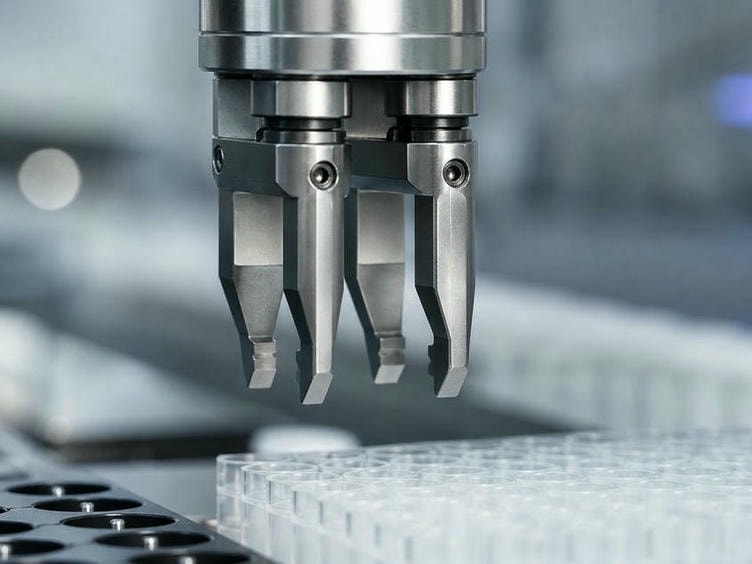
Precision Engineering for EOAT
The performance of an automated handling system depends on the contact mechanics between the gripper and the part. We work directly from your CAD models to produce fingers and jaws that match the geometry of the part being handled.
Profile Matching
Fingers machined to the exact contour of your workpiece for stable contact and no slippage.
Lightweight Design
High-strength, low-density materials minimize payload, enabling faster cycles and less actuator wear.
Custom Interfaces
Mounting patterns that integrate directly with standard and custom gripper bases or tool changers.
Soft Jaws
Sacrificial or form-fitting jaws for delicate parts needing high-surface-area contact without damage.
Material Selection for Robotics Applications
Choosing the right material is critical for balancing durability, weight, and cost. We machine a variety of materials suitable for EOAT applications.
Aluminum (6061-T6, 7075-T6)
The standard for most gripper fingers. 7075-T6 delivers high strength-to-weight ratios for heavy-duty applications.
Stainless Steel (303, 316, 17-4PH)
For food-grade environments, medical robotics, or applications requiring high corrosion resistance and durability.
Engineering Plastics (POM/Delrin, PEEK, Nylon)
Ideal for non-marring contact with fragile or finished parts. PEEK offers excellent wear resistance in harsh environments.
Brass & Bronze
Used where non-sparking properties or specific friction coefficients are required.
CNC Machining Capabilities
We utilize 3-axis, 4-axis, and 5-axis CNC milling to produce gripper components with complex geometries — non-parallel gripping surfaces, intricate mounting holes, and recessed areas for sensor integration.
Tight Tolerance Machining
Critical fits for dowel pins, bearings, and mounting interfaces are held to ensure repeatability after tool changes.
Multi-Setup Machining
Complex parts requiring access to multiple sides are processed efficiently, holding geometric relationships such as parallelism and perpendicularity within specification.
Small-Batch and Production
From a single prototype for proof-of-concept to 500 sets for a production line, our flexible setup allows efficient manufacturing across all volume tiers.
Complex Geometry Expertise
Non-parallel gripping surfaces, intricate mounting holes, and recessed sensor pockets machined to your CAD data.
Surface Treatments for Performance
Surface finish affects grip, wear, and environmental resistance. We offer a range of secondary processes to tailor the gripper's performance to the application.
Hard Anodizing
Increases surface hardness and wear resistance for aluminum fingers used in high-cycle environments.
Bead Blasting
Provides a matte finish and can increase surface friction for better grip.
Electroless Nickel Plating
Improves corrosion resistance and provides a uniform coating on complex geometries.
Laser Marking
Essential for identification in multi-SKU automation systems, allowing quick retrieval of the correct finger set for specific jobs.
Quality Control and Inspection
In robotics, a variation of a few tenths of a millimeter can result in dropped parts or damaged equipment. We verify every part against your drawings using calibrated measurement tools.
Documentation on request
CMM inspection reports and certificates of conformance to support your quality management systems.
True Position
Mounting holes and dowel pins align perfectly with the gripper base.
Form Tolerances
Flatness and perpendicularity of gripping surfaces are checked to ensure uniform force distribution.
Dimensional Accuracy
CMM and precision gauges verify that critical interfaces meet required tolerances, typically ±0.01 mm.
From Prototype to Production
We support the full lifecycle of your automation project.
Prototyping
Single-piece or small-batch samples for testing new gripping strategies. Prototype lead times are typically 3–7 working days for rapid iteration of finger designs.
Low-Volume Manufacturing
As your project moves to pilot production, we scale to batch quantities, ensuring consistent quality across all sets.
Repeat Production
For established lines, we optimize manufacturing processes to provide cost-effective, repeatable parts with consistent lead times.
Request a Quote
To receive a quote for your custom gripper fingers or jaws, send your project details to our engineering team.
- 013D CAD files (STEP or IGES preferred)
- 022D drawings (PDF with dimensions and tolerances)
- 03Material requirements
- 04Quantity
- 05Surface treatment specifications
RobotPartsCNC
· info@robotpartscnc.com
Precision CNC Manufacturing for Robotics & Automation